
Journalists hate AI-generated PR just like the rest of us
A case study of how journalists react to AI-generated expert quotes after a year of Pangram's integration on Featured platforms


Introduction
Journalists need sources when writing an article. Tracking down sources to comment on a topic, like experts in a medical field or business owners affected by a policy decision, can be time consuming.
This is where platforms like Help a Reporter Out (HARO) come in. It works like this: A journalist is writing an article, say, on a new health trend, and they would like to include an expert opinion from a doctor. That journalist will submit a request to HARO with the question they want answered, and the qualifications or background they need the source to have. HARO then distributes the reporter’s request to a list of possible sources, and those sources, if they meet the criteria, can send back a pitch in response to the question.
HARO was founded in 2008 and it quickly became one of the largest forums of its kind. But, in 2023, HARO started facing a problem: people were using AI to generate responses to journalist requests, hoping to get high-profile features in news articles and increase brand awareness. In response to the influx of low-quality sources, journalists abandoned the platform en masse for verification-gated platforms, and HARO was officially discontinued in 2024.
When Featured acquired and revived HARO in 2025, it needed a way to ensure the quality of source responses in the age of high-volume, AI-generated public relations. It did so by integrating Pangram into its platform, and we now have a year of data on how that worked out.
Why do people submit AI generated pitches?
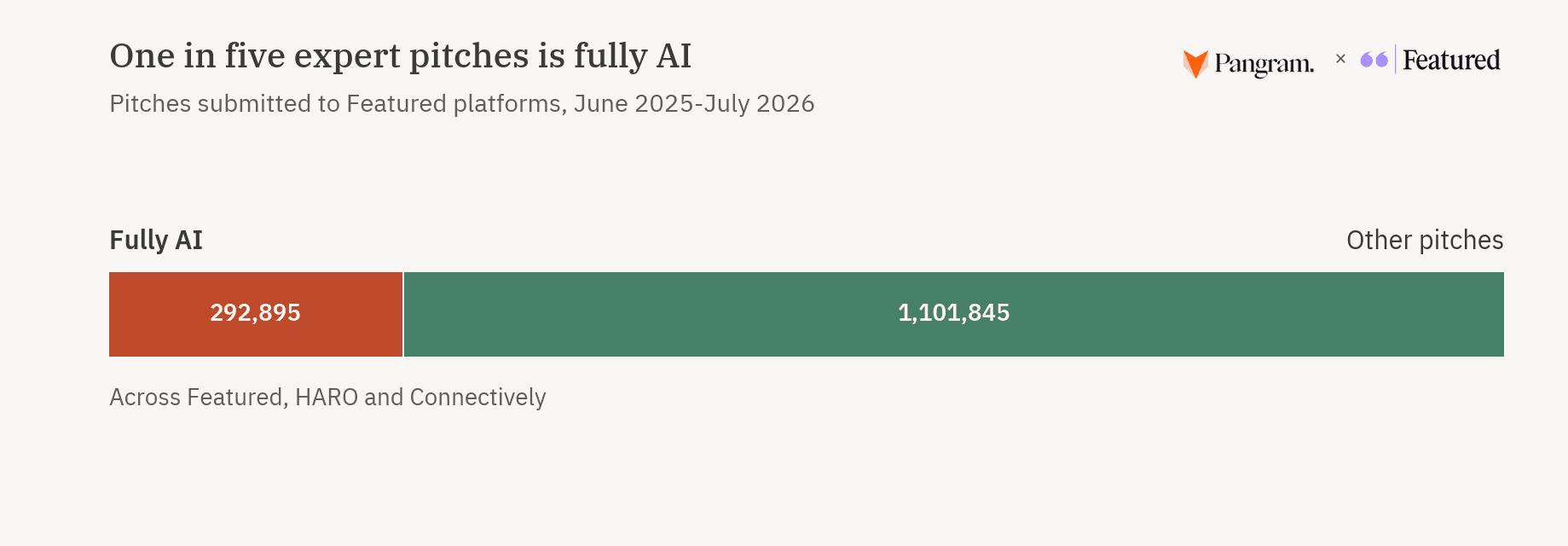
Across its three platforms (Featured, HARO, and Connectively), Featured received 1,394,740 pitches in response to 42,392 journalist requests between June 2025 and July 2026. Of those, Pangram flagged 292,895, or roughly 21%, as fully AI-generated.
In contrast to the paid media coverage that comes from, say, distributing a press release, HARO offers sources earned credibility and brand awareness by providing audience exposure if a journalist selects your pitch. Reporters, on the other side of the trade, do not have to spend as much time hunting down sources. HARO is ad supported and it does not pay sources for providing pitches.
This is the motivation for using AI to respond to pitch requests: if a person or company wants to maximize its earned media coverage, one strategy could be to use an AI public relations service that automatically responds to journalist requests on a platform like HARO, hoping to land as many press features as possible.
On competing platforms, this strategy sometimes works, as it did in the case of Dr Eleni Nicolaou, a supposed art therapist whose fully AI-generated quotes appeared more than 30 times in publications including Vice, Forbes, and Glamour — and who likely does not exist at all.
Journalists do not want to quote fully AI-generated experts
On Featured platforms at least, this strategy of overwhelming journalists with AI-generated pitches does not pay off. Featured’s data shows that many journalists on HARO prefer not to receive AI-generated pitches altogether: out of a pool of more than 2500 journalists, 35% select an option to not receive pitches that Pangram flagged as fully AI-generated, even though the option to screen pitches is off by default.
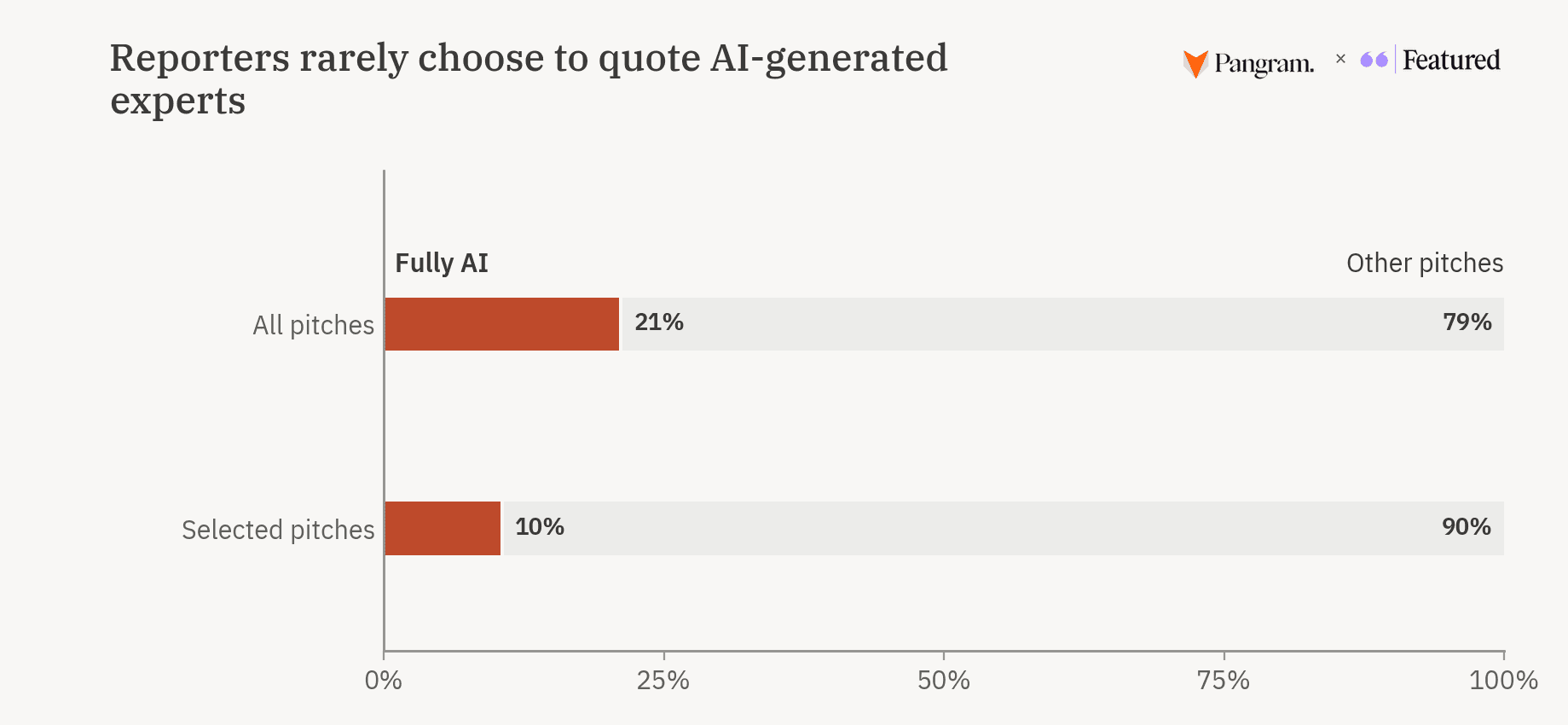
Even when journalists don’t opt out of receiving AI-generated pitches, they do poorly compared to human authored ones. Across Featured, only 1 in 10 AI-generated pitches are selected by journalists for publication; in contrast, approximately 1 in 3 human pitches are selected to be featured in an article.
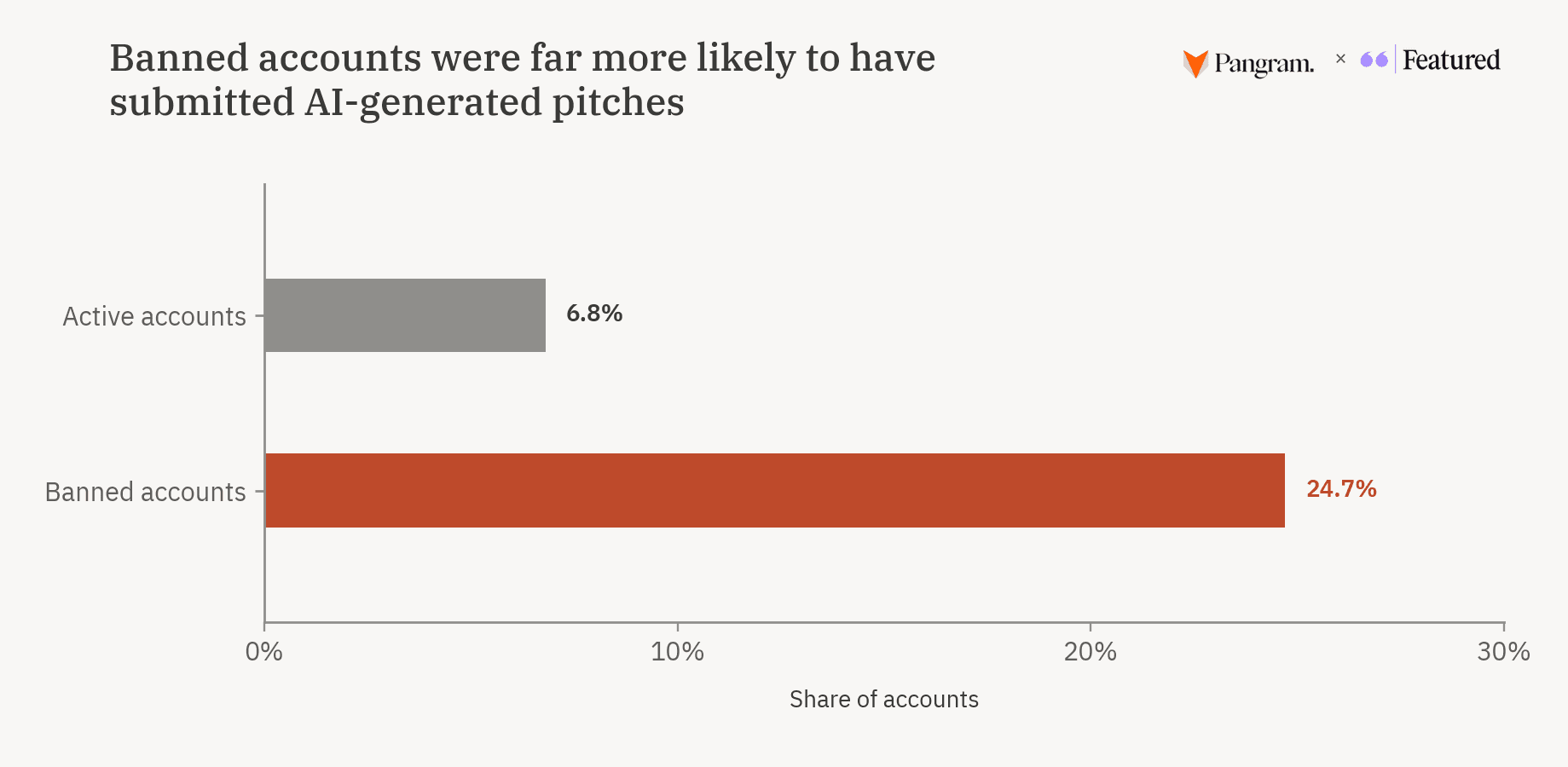
AI-generated pitches were often a sign of abnormal or automated behavior. Banned accounts are roughly 3.6x more likely to have an AI-flagged pitch than active ones: 24.7% of banned accounts have at least one pitch that was flagged as 100% AI-generated, whereas 6.8% of active accounts have at least one fully AI-generated pitch.
HARO does not ban source accounts solely because they submit AI-generated pitches, but AI-generated pitches are one flag that can trigger internal monitoring. By filtering out accounts that submit a large volume of low-quality AI-generated responses, HARO is able to maintain the trust that makes the platform function.
Methodology
For this analysis, Featured supplied us aggregate data for pitches submitted to their platform. Between June 2025 and July 2026, Featured used Pangram to score 1,394,740 pitches responding to 42,392 journalist requests on Featured, HARO, and Connectively. Mixed and AI-assisted classifications were excluded from the comparison.
Conclusion
Journalists need platforms like HARO and Connectively to find experts and people with firsthand experience. The data indicates that people submitting fully AI-generated pitches are failing to meet that bar, as journalists choose human-written pitches over AI, or filter out AI pitches altogether. Featured is using Pangram to help preserve the trust and human expertise that makes journalism valuable.

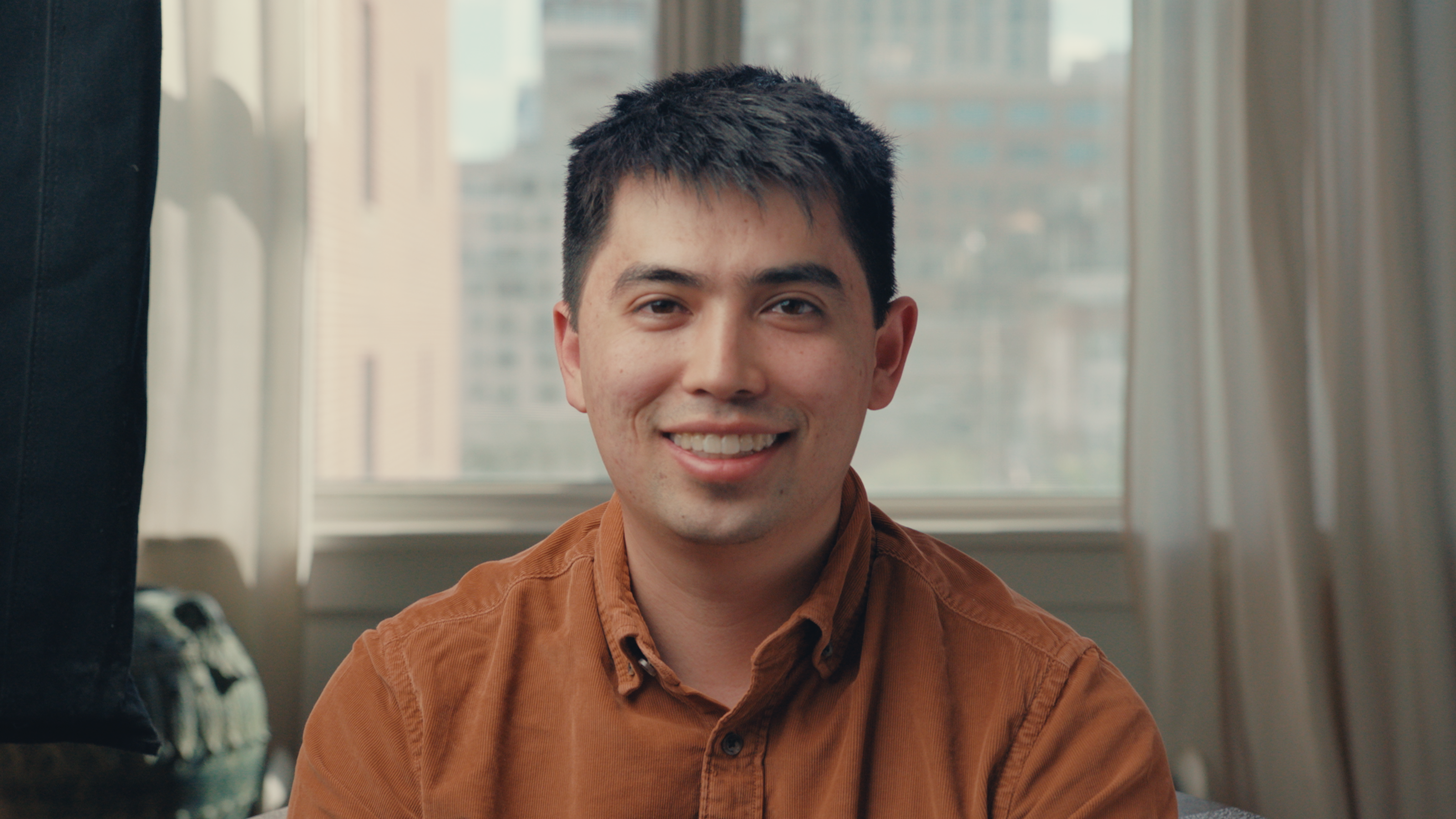
Max is a seasoned machine learning engineer. He most recently worked on autonomous vehicles at Nuro, leading their active learning effort. He has a long history of deploying successful machine learning products at Google, Two Sigma, and Yelp.
Max holds a B.S. in theoretical computer science and an M.S. in artificial intelligence from Stanford University. In addition to his passion for building, he is also an active member of the Magic: the Gathering cube community.
Related reading

Pangram's Performance on a Colluding Agent Swarm
Pangram Predicts 21% of ICLR Reviews are AI-Generated
Three percent of front-page Amazon reviews are now AI-generated
Can Pangram detect Claude Opus 5.5?

AI Helps Write Nearly 50% of Press Releases